Dental Implants near Wauwatosa: Fixed New Teeth, Often in One Day
You're tired of patching. The crown that's been redone twice. The molar that's been "we'll watch it" for three years. The partial that clicks when you eat and tastes like plastic by noon. Somewhere along the way, you stopped chewing on one side. Steak left the rotation. Apples too.
Most patients we see from Tosa arrive at the same realization. Years of one-tooth-at-a-time fixes are adding up to one bigger problem — and they want a real answer this time.
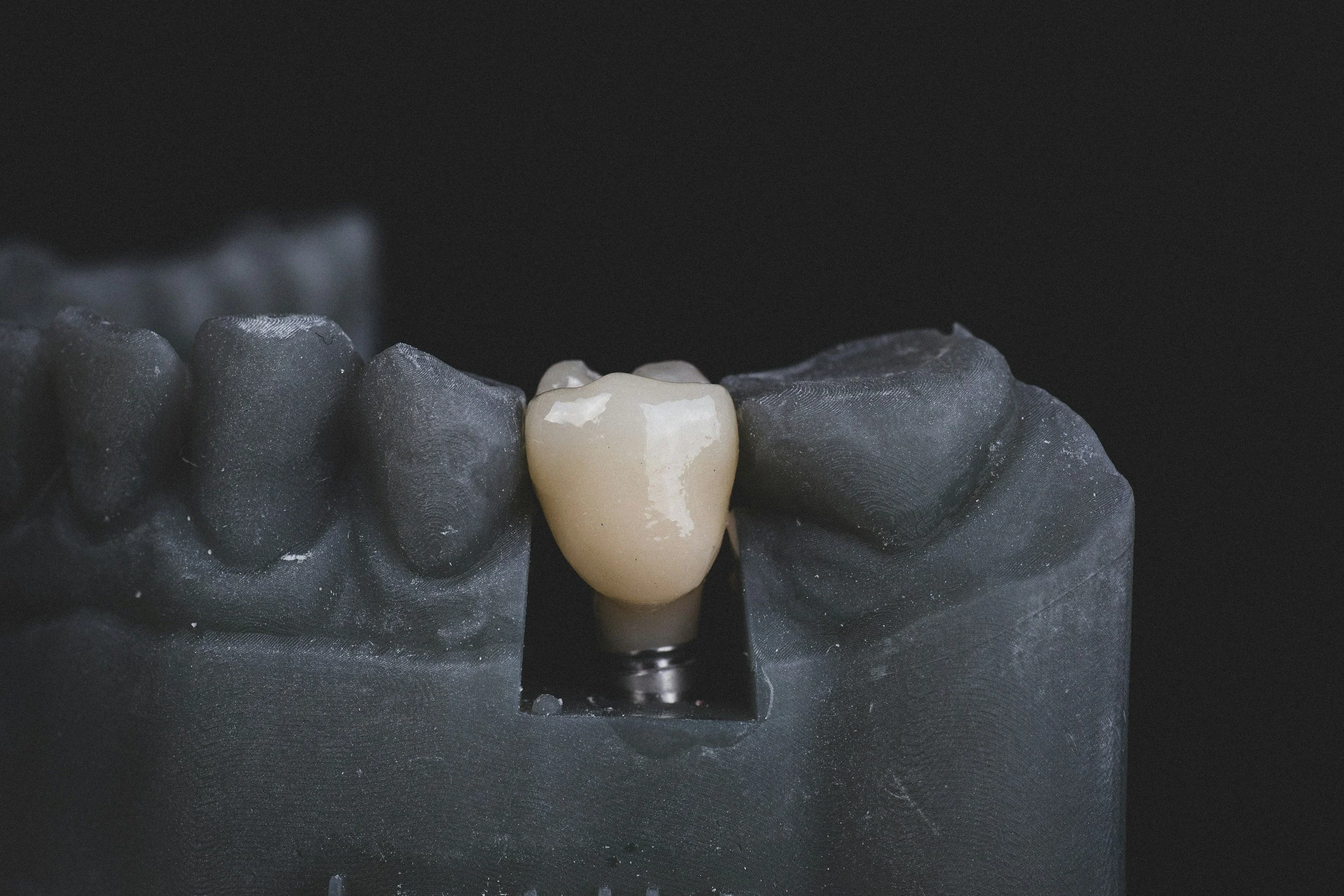
Dental implants are that answer. Implants replace the root of the tooth, not just the part you see. They don't come out at night. They don't slip during dinner. For people missing one tooth, several, or a full arch, implants are usually the most permanent option available.
This page covers what's involved — single implants, full-arch All-on-X, and metal-free zirconia. The technology behind the planning. The sedation choices. And the drive from Tosa Village, which runs about 20 minutes. Schedule an appointment or call 414-963-9440 when you're ready to talk through your case.
Failing Teeth and Loose Partials Have a Permanent Answer
The patients we see from Tosa tend to be in their 50s and up. Many work in or near the Froedtert and Medical College corridor — people who know clinical competence when they see it, and won't settle for less.
The signs we hear about most:
Chewing on one side because the other side hurts or feels weak
Avoiding steak, apples, corn on the cob
A denture or partial that clicks, slips, or comes out at night
Old crowns that keep failing every few years
A front tooth that's been root-canaled twice and is on borrowed time
This didn't happen because you neglected your mouth. It happened because the patch-and-watch model adds up. Years of fixes, one at a time, lead to a moment when the math finally breaks. That moment isn't shameful. It's just the right time to ask a different question.
The right question is no longer "can we save this tooth one more time?" It's "what's a permanent solution that I won't have to revisit in five years?"
All-on-X Replaces a Full Arch on Four to Six Implants
When most of an arch is failing — or already gone — replacing teeth one by one doesn't make sense anymore. All-on-X handles the whole arch with one fixed bridge, anchored to four to six implants.
What that means in practice:
It doesn't come out. No soaking cup, no adhesive, no clicking.
Fewer surgeries than placing a separate implant for every tooth.
You bite, chew, and laugh the way you did before things started failing.
If you're not a full-arch case, single implants and multi-tooth bridges are still on the table. The plan depends on what's actually in your mouth, not what we'd like to sell.
Honest talk on candidacy: bone loss, health history, and smoking get evaluated, not glossed over. The American Academy of Implant Dentistry's overview of dental implants is a good third-party read if you want one. Dr. Schneiss is an AAID Associate Fellow — a credential held by only 6% of US dentists.
Patients also drive in from Elm Grove and Brookfield for full-arch planning. The drive is short. The decision lasts decades.
3D Planning Happens Before Anyone Picks Up an Instrument
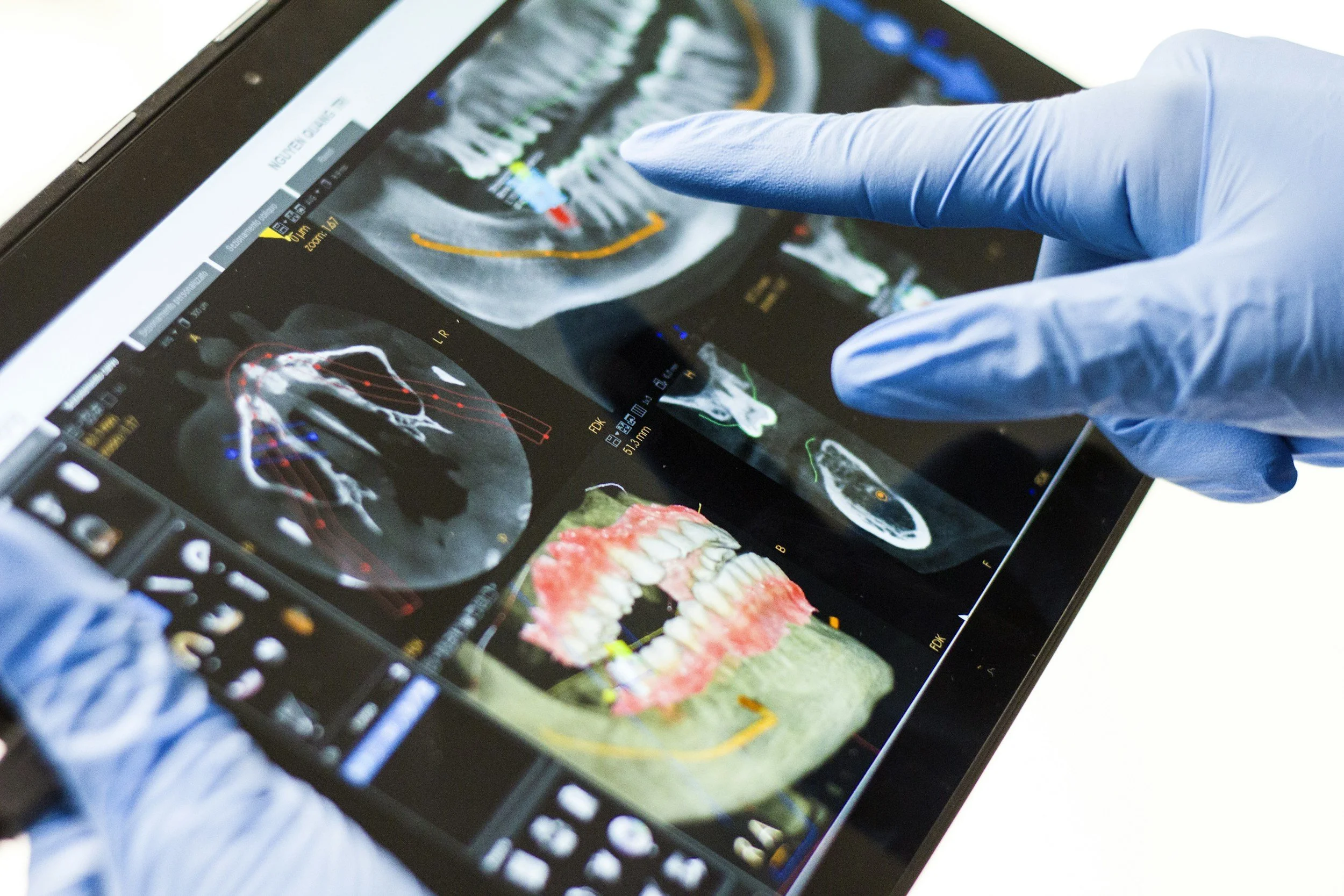
The biggest difference between a good implant case and a bad one isn't surgery day. It's what happens before it.
We start with a CBCT scan — a 3D image of your jaw that shows bone volume, nerve position, and where your sinuses sit. From that scan, we plan exactly where each implant will go. The plan is then turned into a custom surgical guide, so placement on the day matches placement on the screen. That's what computer-guided implant surgery means. Shorter procedures. More precise angles. Fewer surprises.
If bone grafting or a sinus lift is needed, that's figured out at planning — not mid-treatment. You see your case in 3D before you commit to anything.
This is also the visit when your spouse is welcome to sit in. Many Tosa couples decide together, and that's how it should be. Reserve your visit when you're ready to see your scan.
Surgery Day Often Ends With Fixed Temporary Teeth
For the right cases, surgery day is also the day you leave with teeth.
Here's how it runs: failing teeth come out, implants go in, and a fixed temporary bridge is attached the same day. People call this "Teeth in a Day." It's real, with one caveat — not every case qualifies. Whether you do depends on what your scan shows.
Sedation runs the full menu, matched to your health history and how you feel about being there:
Nitrous oxide for light anxiety
Oral sedation for deeper calm
Twilight or IV sedation for longer procedures
General anesthesia for complex cases
You're monitored throughout. Recovery instructions are clear — what to eat, when you can return to work, when each follow-up happens. The American Dental Association notes that implant procedures and recovery vary by case complexity, which is why your plan is built around your specifics, not a template.
A small Tosa detail: if you have a companion driver, there's coffee and a walk down Downer Avenue available during the procedure.
Zirconia and Healing Protocols Built for the Long Haul
Once the implants integrate with the bone, the final restoration goes on top. Options here matter.
The final bridge can be made from zirconia — strong, metal-free, and natural-looking. Zirconia implants themselves are also available for patients who want a fully metal-free mouth. That's rare among Milwaukee-area implant providers, and it's something patients with sensitivities or biocompatibility concerns specifically search out.
We also use PRF therapy when surgical healing is involved. PRF is short for platelet-rich fibrin — it's drawn from your own blood, spun down, and placed at the surgical site to support healing. No foreign material. Your body, doing what it already knows how to do.
The verification step matters too. Before the final bridge is placed, we confirm integration. Nothing gets rushed because rushing is how cases fail at five years. The goal is one permanent solution, not another patch. Patients from the North Shore and Waukesha County specifically choose this boutique model over high-volume chains — and that's the trade. Slower visits. Longer-lasting results.
The Drive From Tosa Is Easy and Worth It
Our office is at 2524 E Webster Pl #201, Milwaukee, WI 53211, on the East Side near UWM and Historic Downer Avenue. From Tosa Village, the drive runs about 20 minutes.
Two main routes work:
North Avenue east. The straight shot, especially from East Tosa.
I-94 east to the East Side exits. Faster during rush hour.
East Tosa patients along the North Avenue corridor are even closer. Free street parking plus on-site parking at the building — easier than event-day parking near Hart Park. The entrance, lot, and restroom are all wheelchair accessible.
For an implant case that may span six months to a year, the convenience matters. A local boutique practice beats a fly-in chain for the long arc of treatment. You'll be back for planning, surgery, follow-ups, and the final restoration. Twenty minutes makes that simple.
Ready to see your case in 3D? Get in touch or call 414-963-9440. The first visit is a CBCT scan and a real conversation — no pressure, no upsell.
Frequently Asked Questions
How long is the drive from Wauwatosa Village to your office? About 20 minutes east via North Avenue or I-94. Free street and on-site parking on arrival.
Can I really get teeth the same day as surgery? Often yes — a fixed temporary set is attached the same day implants are placed, when your scan supports it. Not every case qualifies, but many do.
I was told I don't have enough bone. Am I out of options? Usually not — bone grafting and sinus lifts can rebuild support before or alongside implants. A CBCT scan tells us what's possible in your specific case.
Can I be fully asleep for implant surgery? Yes — IV sedation and general anesthesia are both available, especially for complex cases or high anxiety. We match the sedation level to your health history.
How many visits will the full process take? Typically a planning visit, surgery day, and several checkups over three to six months. Some cases run longer when grafting or full-arch work is involved.
Is there a metal-free implant option? Yes — zirconia ceramic implants are available for patients who want to avoid titanium. They're a rare option in the Milwaukee area, and they suit patients with sensitivities or biocompatibility concerns.
